

Miniaturization, robustness, adaptive functions and maximum reliability are decisive factors for the performance of defence and aerospace technologies today. In this environment, nitinol, a nickel-titanium alloy with shape memory effect and superelasticity, is becoming increasingly important as a key material for innovative systems. With EO-M-026, Emil Otto offers a specially developed high-performance flux that is precisely tailored to the processing of nitinol and nickel alloys.
The challenge of soldering nitinol oxide layer as a critical factor
Soldering nitinol is one of the greatest challenges in assembly and connection technology. This is due to the extremely stable titanium oxide layer that forms immediately after contact with air and virtually prevents reliable wetting. Conventional fluxes reach their limits here, as they do not sufficiently remove the oxide layer or leave behind critical residues.
The flux EO-M-026 addresses precisely this problem:
- Targeted removal of the titanium oxide layer
- Activation of surfaces that are difficult to wet
- Minimization of corrosive residues
- Maximum process stability
High-performance flux EO-M-026 for safe processes
EO-M-026 has been specially developed to meet these requirements. The combination of highly active inorganic activators and complex organic additives enables:
- Reliable wetting even on oxidized surfaces
- Clean, low-residue processes
- High process reliability in automated production environments
The flux is zinc and halide-free, non-flammable and VOC-free, making it suitable for modern, safety-critical production environments.
By supporting common application methods, from manual processes to selective or laser-based soldering, EO-M-026 can be flexibly integrated into existing production lines.
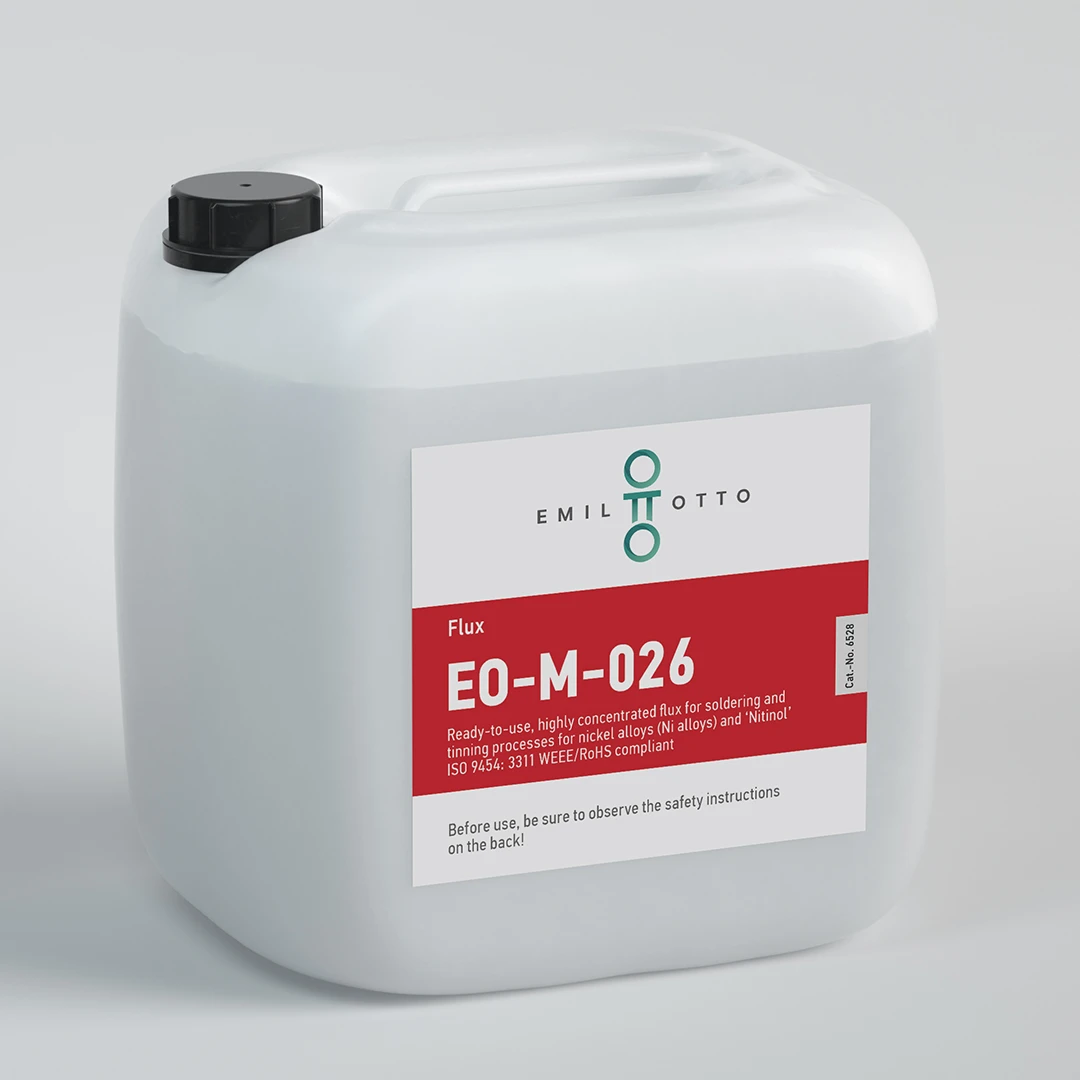
EO-M-026
Soldering and tinning processes for nickel alloys as well as 'nitinol'
Ready-to-use, highly concentrated flux
Type: ISO-9454: 3311 (WEEE/RoHS compliant)
Enabler for military technologies and aerospace applications
EO-M-026 is a specialized flux that makes the processing of Nitinol process-safe and industrially scalable for the first time. This makes it a key enabler for modern military technologies, from UAV systems and adaptive structures to highly sensitive electronic assemblies.
This makes the flux a decisive process component, not only supporting but functionally indispensable for the production of resilient soldered joints. In the defense industry in particular, the quality of the joining technology determines the operational capability of complete systems.
Typical military applications of nitinol
Self-adjusting wings or air ducts in UAVs and missiles
Applications in sensor technology, optics and portable equipment
Autonomous control mechanisms in fuel or hydraulic systems
Reliable separation mechanisms without explosive components
Protection of sensitive electronics in communication and target systems
These applications are based directly on the unique material properties of nitinol, in particular the shape memory effect and superelasticity, which enable mechanical functions without conventional drive systems.
Precision in processing as a success factor
As powerful as nitinol is, its processing is just as demanding. Even minor deviations in the soldering process can permanently impair the functional properties, such as the shape memory effect. Precisely controlled thermal processes, adapted solder alloys and precisely coordinated fluxes are therefore crucial. Only through this interaction can it be ensured that the mechanical and functional properties of the material are retained. This is a basic requirement for military systems with long operating times and extreme loads.
At a time when performance, reliability and miniaturization are decisive for technological superiority, connection technology therefore has a key role to play. EO-M-026 provides the necessary process basis for this.
Find out more about our fluxes for soft soldering a wide range of metals: