
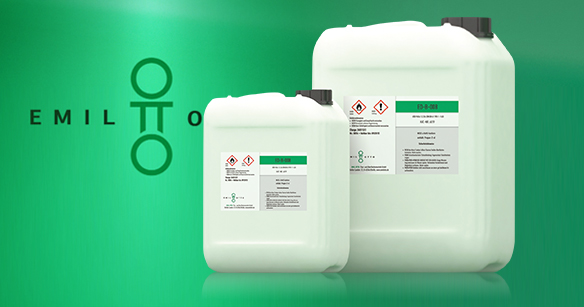
"The new developments are based on customer requests," explains Markus Geßner, Head of Marketing and Sales at Emil Otto GmbH. The series of tests with all the newly developed fluxes started back in November. These fluxes were used in wave and selective soldering in a series of reproducible tests. The alcohol-based new developments are the first and will be officially available from March.
These are multi-fluxers that can be used for a wide range of soldering tasks. In addition to wave and selective soldering processes, many companies also use hand and dip soldering. The alcohol-based fluxes from Emil Otto GmbH are designed for this wide range of applications. If, in electronics production, the wave soldering system only runs on certain days of the month, but manual soldering is carried out daily with different tasks, a flux is required that has good soldering and application properties for each individual application. This not only minimizes storage costs for the customer, but also avoids potential sources of error caused by accidentally mixing up the fluxes.
All fluxes in the Multi-Flux range comply with DIN EN 61 190-1-1 with L0 classification in terms of corrosion behavior, freedom from halogens and surface resistance of uncleaned flux residues. In addition, they have been tested for SIR behavior according to an "Emil Otto in-house test" based on the above-mentioned standard and recommendations from the Fraunhofer Institute in Oberpfaffenhofen. "All new products in the Multi-Flux series have passed the tests and are therefore approved for customer use. The soldering behavior and the cleanliness of the PCB surface were particularly remarkable," says Geßner, looking back.
Product variants A, B and C have been developed for the fluxes EO-B-001, EO-B-002 and EO-B-07. "We can therefore offer customers products that are even more tailored to their area of application," emphasizes Geßner. The A variants generally have a low solids content of 1-2%. These variants were specially developed for full-tunnel nitrogen applications and guarantee a better soldering result under full nitrogen thanks to a wide process window and high temperature stability.
The B variants, on the other hand, correspond to the standard version, with a solids content of 3%. This is the all-round version, which Emil Otto already offered on the market. The B version is also available as a dosing pen or dosing bottle and is therefore ideal for small applications.
The range is rounded off by the C variants, which have a solid content of 4%. These were specially developed for power electronics, where large component bodies have to be soldered with a low placement density.
In addition to the alcohol-based fluxes already developed and launched on the market last year, further fluxes have been added to the range: EO-B-006, EO-B-007 and EO-B-008. EO-B-006 is a resin-free flux. EO-B-007 is a cost-effective alternative flux that can be used for wave, selective and hand soldering.
With 4% solids content, EO-B-008 has a high solids content. EO-B-008 was developed especially for short wave soldering systems where the PCB spends a holding time in the preheating phase. The subsequent soldering process takes place in a very active wave. Thanks to the EO-B-008, the PCB has very good soldering results with a very clean surface after the soldering process.