
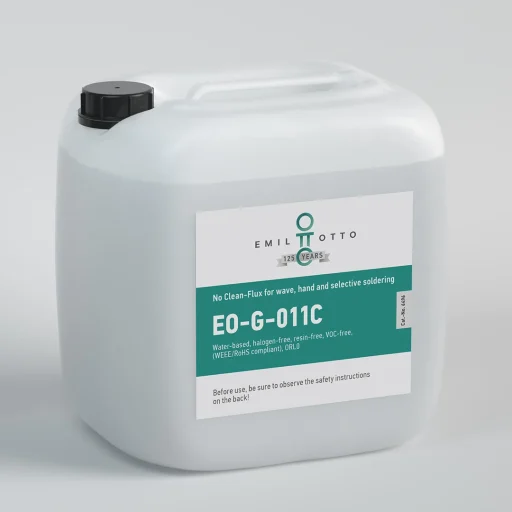
Water-based flux EO-G-011C

Recommended method of application

Wave, manual and selective soldering

No Clean-Flux, water-based
Di-carboxylic acid complex, VOC-free, halogen-free, resin-free (WEEE/RoHS-compliant)
Type ISO-9454: 2131 / DIN EN 61190-1-1 (according to J-STD004): L0 (IPC: ORL0)

Cat.-No. 6496
6496_EO-G-011C_Kanister_EN

Technical data

Appearance:colourless, transparent liquid
Hazardous goods:no
VOC:0.0 %, water-based
Solids content:3.8 - 4.2 wt.-%
Density at 20 °C:1.00 - 1.03 g/ml
Acid number:33 - 38 mg KOH/g
Resiny:no
Activators/resin:di-carboxylic acid complex, VOC-free, halogen-free, resin-free
Solvent:water with additives
Flash point:not applicable
Storage conditions:cool and dry in the sealed original container at 5 – 25 °C
Durability:12 months

Description

EO-G-011C is a no-clean flux, universally suitable for wave and selective soldering of printed circuit boards and contains organic, halogen-free and resin-free, activating additives specially adapted to the soldering processes. This flux has been developed in a combination with lead and lead-free solders specially adapted to the thermal requirements of the soldering process.

EO-G-011C is based on a novel formulation to stabilize and improve the application process and residue behaviour compared to conventional water or partially water based fluxes. This flux leaves no sticky residue.
EO-G-011C is a water-based electronic flux and non-corrosive. The solids content is 4%.

Customer added value

  • Non-flammable (no legal restrictions for transportation, storage and handling)
  • Very good soldering properties (capillarity, wetting)
  • Broad process window (high thermal stability, good activity over a long interval)
  • Very good residue behavior (optically clean, high SIR)

Recommendations for the processing of this flux:

This flux must be applied by spraying. After application, it is advisable to dry the flux in order to transform the liquid into fusible phase which favours the soldering operation.

Foam fluxes: Not recommended

Spray fluxing: If dosing is possible, first set the flux quantity to 15 – 20 ml/min, observe the even flux distribution on the PCB (test with thermal paper if necessary) and then correct to the optimum quantity.

Preheating: For “simple” PCBs a preheating temperature of 80 – 110 °C is recommended, for “more complex” PCBs 110 – 130 °C on the top side of the PCB. It can be used in both leaded and lead-free solder systems.

Packaging units

Canister: 5 l, 20 l
Extras: Other packaging units on request

Would you like to find out more?

Email address (business)
Country
Privacy policy
Newsletter
Position: 0
Slide to 5 to confirm you’re human.
Product information: EO-G-011C