
Press-fit contacts are designed for solderless connections. However, if these components are processed using wave or selective soldering processes, wetting problems and incomplete solder penetration may occur. Emil Otto explains the technical causes and demonstrates how better soldering results can be achieved by properly coordinating the flux, process parameters, and component surfaces.
Press-fit contacts are used in electronics manufacturing, particularly in applications where reliable electrical connections and high mechanical stability are required. However, their design and surface finish are primarily optimized for the press-fit process. While their press-fit performance is qualified in accordance with IEC 60352-5, this does not necessarily guarantee solderability in accordance with J-STD-002.
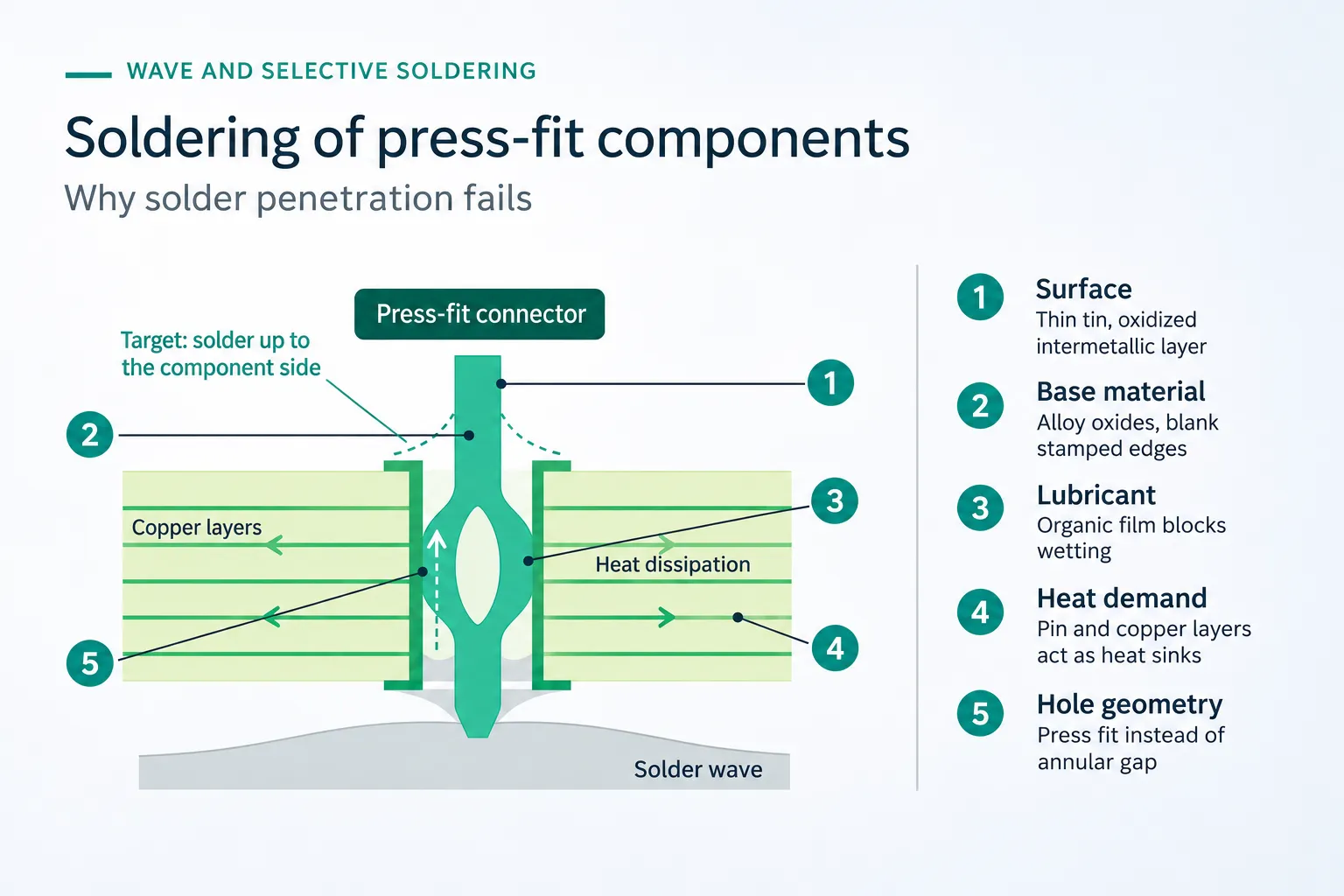
If such contacts are to be soldered nonetheless, various material- and process-related factors can impair solder penetration. These include, in particular, thin tin surfaces, oxides that are difficult to reduce, lubricant residues, high heat requirements, and the specific geometry of the press-fit holes.
Different causes require tailored solutions
A key factor is the surface condition of the contacts. The tin layer, which is often only a few micrometers thick, can lose its solderability due to aging and the formation of intermetallic phases. In addition, oxides on the copper alloys used, as well as possible lubricant residues, can prevent complete wetting.
Thermal conditions also play a crucial role. Solid press-fit zones and thick multilayer printed circuit boards result in increased heat dissipation. As a result, the contact may not reach the required wetting temperature under certain circumstances. At the same time, the hole geometry optimized for a press fit can impede the capillary rise of the solder.
Choosing the Right Flux and Other Important Factors for Success
In addition to the flux, there are other factors to consider in order to achieve good soldering results:
-
Flux:
High-activity flux systems should be used that reliably remove oxides from tin and intermetallic surfaces. Furthermore, halide-containing types may only be used after approval and verification of residue reliability (J-STD-004, SIR). The flux must rise through the sleeve to the assembly side, and water-based systems require sufficient preheating to dry. -
Process:
Preheating should be adjusted based on the top surface temperature. In addition, the contact time should be extended or the conveyor speed reduced, and nitrogen should be used to prevent reoxidation. -
Material:
Users should request solderable component versions with a thicker pure tin coating and solderability certification. Aged components can be hot-dip tin-plated, but are no longer specified for press-fitting after that. Before starting mass production, test the batch using a wetting balance test (J-STD-002, IEC 60068-2-69).
In short: The poor solderability of press-fit components is not a defect, but rather a consequence of their design. It can be controlled through the interaction of flux, heat input, and the component surface, because no amount of flux can compensate for a lack of heat or a missing solder gap.
„The solderability of press-fit components cannot be improved solely through the action of the flux. The key lies in the interplay between surface finish, flux chemistry, heat input, and component geometry. Reproducible soldering results can only be achieved when these factors are properly balanced.“
Markus Geßner, Head of Marketing and Sales at Emil Otto Ltd.
Application support for stable soldering processes
As a specialist in fluxes and surface technology, Emil Otto assists electronics manufacturers in analyzing wetting problems and selecting suitable flux systems. The focus is on evaluating the specific materials and process conditions involved.
Through targeted process trials and the selection of appropriate fluxes, the conditions for improved solder penetration can be established. However, it is important to note that even highly active fluxes cannot fully compensate for insufficient heat input or the absence of a solder gap.
Emil Otto'The company's application engineering team provides support in root cause analysis, flux selection, and the optimization of existing soldering processes.